Faculty Spotlight: Laura Berman on Developing Number Sense
Updated: Aug 27
This week, Touchstone’s Laura Berman, Director of Special Education and math teacher, presented at the Mathematics Without Limits conference, hosted by the Association for Teachers of Mathematics in New England. Her workshop invited educators to reconsider one of the most familiar yet often overlooked tools in math instruction: the number line.
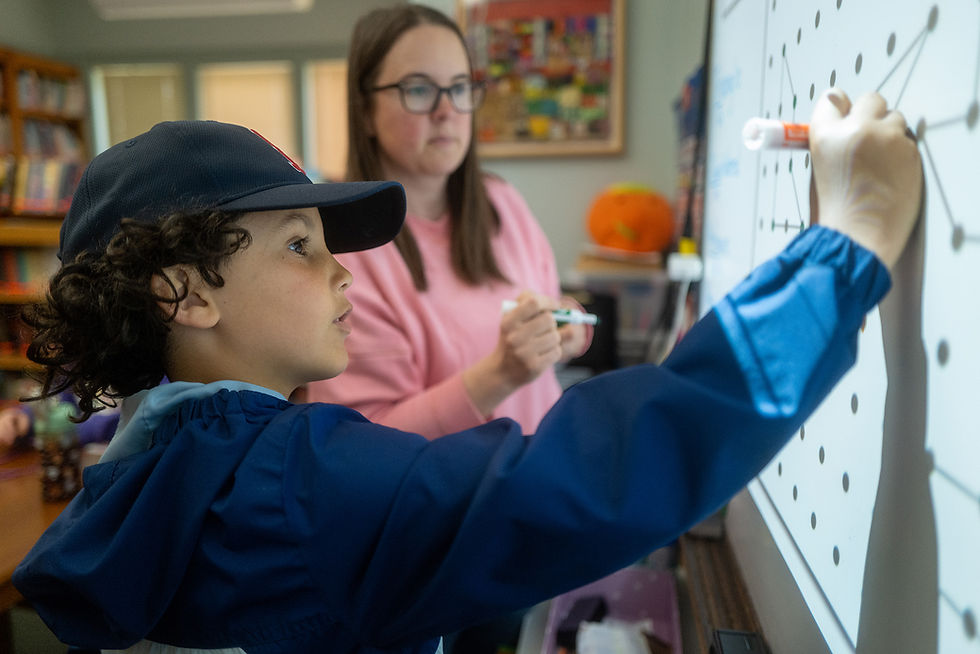
“The number line is often something in our curriculums,” Laura shared, “but is viewed as just another box to check, not something that’s actually meaningful to teachers or students. I want to challenge that misconception, because it can be a powerful tool to build students’ understanding of numbers and operations. It can also provide valuable context for comparing numbers and rounding, plus its obvious connections to measurement and graphing.”
Before heading to the conference, Laura offered a preview of her workshop to several Touchstone teachers, sparking rich conversations about how to deepen our collective approach to number sense. Her presentation highlighted how the number line and the thinking it represents shows up throughout our classrooms in developmentally meaningful ways:
In early childhood, children jump from stump to stump around the circle, counting their hops as they go.
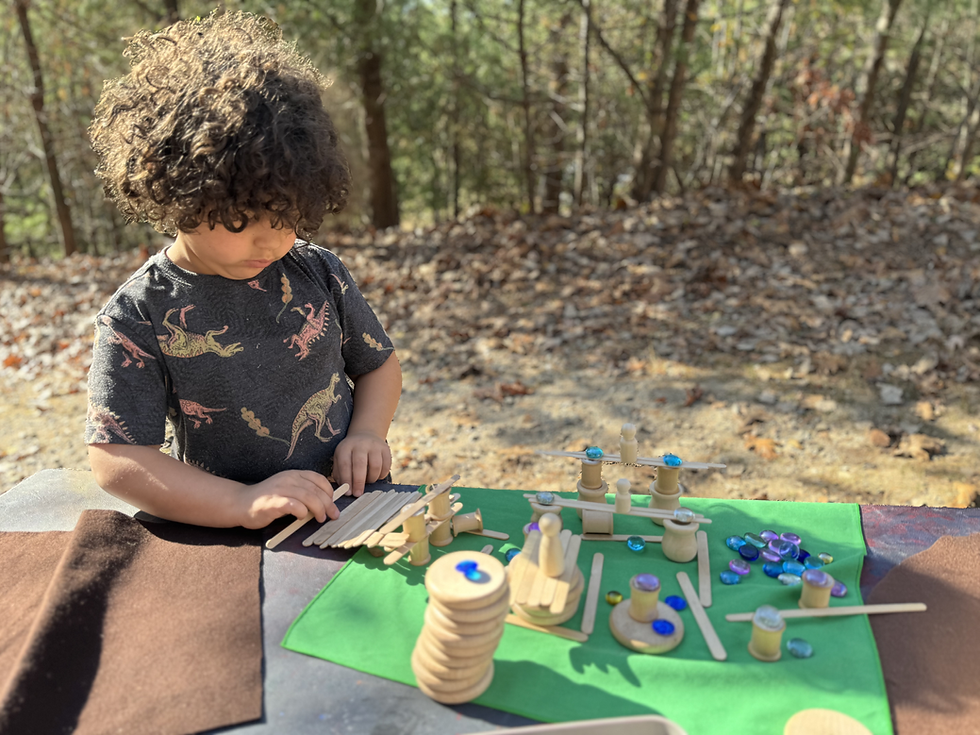
In our elementary classrooms, students measure a frog jump, a rabbit jump, and a kid jump using popsicle sticks, exploring length, comparison, and estimation.
And in the middle school grades, students work with positive and negative numbers, seeing how relationships between numbers extend across contexts.
At Touchstone, we believe number sense is more than a set of skills, it’s a kind of intuition, “a special feel for numbers, an understanding of how they are related to each other and the world around us.” Across every level, our inquiry-based approach and real-world applications help students internalize that sense of numbers, making math meaningful, playful, and deeply connected to their lived experiences.
As Laura reminded participants, math learning doesn’t stop at the classroom door, it’s everywhere. In her presentation she included a quick plug for board games as a joyful way to build math fluency and flexible thinking at home. Games like Candy Land, Count Your Chickens and Snail’s Pace Race (for younger children) and Ticket to Ride and Cribbage (for older children and adults) are all excellent games to have in your homes to play with the whole family.
Written by Anne Lewenberg