Why Real-World Work Matters: The Neuroscience Behind What Your Child Is Doing at School
Updated: Aug 27
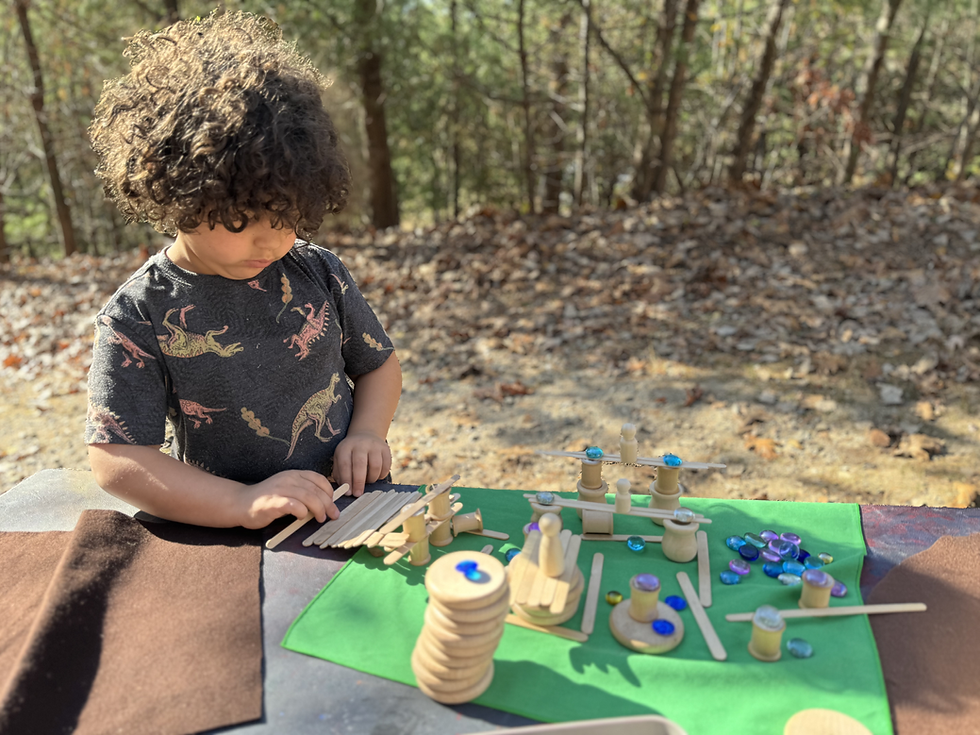
When you walk through our classrooms, you might see a four-year-old hot gluing an invention, a group of five-year-olds designing a city, eight- and nine-year-olds carefully revising pages of a book they plan to publish, or middle school students presenting research on topics they care deeply about. At first glance, these projects may look like imaginative play or early approximations of “real” work.

But neuroscience tells us something important: this is real work.
When children engage in meaningful, self-directed projects, the same core brain systems activate as they do in adults engaged in complex, purposeful tasks. Planning, problem-solving, creativity, language development, and executive function are all at play. The brain does not distinguish between “practice” and “real life” in the way we sometimes do—what matters is that the task is authentic, engaging, and cognitively demanding.
The Brain at Work, Across Ages
In our Goldfinches classroom, four-year-olds are creating inventions—drawing, building, and explaining their ideas. While their designs may be whimsical or not yet functional in an adult sense, their brains are engaging in systems thinking, symbolic representation, and early engineering habits of mind. They are asking: What problem am I solving? How will this work? What should I try next?
In the Cardinals classroom, five-year-olds are taking this further by planning their own city. They are considering community needs, designing infrastructure, and negotiating ideas with peers. This kind of work activates the brain’s prefrontal cortex, supporting planning, decision-making, and flexible thinking, while also strengthening social cognition as they collaborate and revise ideas together.
Our eight and nine year old students in the Hollow and the Grove are publishing their own books. This process—drafting, revising, editing, and sharing with an audience—engages complex language networks and strengthens neural pathways related to organization, persistence, and self-expression. They are not just “learning to write”; they are functioning as authors.
In the Older Student Program, students ages 12–14 design and present independent study projects in fields they are genuinely curious about. They work with mentors, conduct research, synthesize information, and present their findings. This kind of deep, interest-driven work activates higher-order thinking systems in the brain—analysis, evaluation, and creation—while also building identity and a sense of purpose.
Process Over Product—and Why That Matters
It’s true that a four-year-old’s invention may not function like an adult-engineered product, and a student-written book may not mirror professional publishing standards. But from a brain development perspective, that is not the point.
What matters is that children are engaging in the same kinds of thinking as adults:
Generating ideas
Planning and organizing
Testing and revising
Communicating with an audience
Reflecting on their work
These experiences strengthen neural pathways that support lifelong learning. When children do real-world work, their brains are literally wiring themselves for independence, creativity, and problem-solving.
Why We Prioritize This Work at Touchstone
We believe that children learn best when their work is meaningful, connected, and rooted in real-world thinking. By inviting students to invent, design, write, research, and present, we are not asking them to wait until adulthood to do important work, we are recognizing that they are already capable of it.
And perhaps most importantly, when children see themselves as inventors, city planners, authors, and researchers, they begin to build a sense of identity as capable, contributing members of a larger world.
Written by Anne Lewenberg